On Halloween, Choosing Clay Meant You Were Going to Die
Four bowls. One blindfold. A questionable party game.
You are blindfolded. In front of you sit four bowls.
One holds a ring. One holds water. One holds food. One holds clay.
Choose the ring, and marriage is supposedly coming. Water means emigration. Food promises prosperity.
Choose the clay?
Death.
Welcome to an Irish Halloween party. Hopefully, you enjoyed the snacks.
This fortune-telling game is documented by the National Museum of Ireland. People used ordinary objects to predict extraordinary things: who would marry, who would leave, who would prosper, who would die. And there, among the possible futures, sat a bowl of clay.
For a potter, that is a deliciously uncomfortable detail. The stuff we turn into coffee mugs once had a role in delivering the worst party news imaginable.
It also gives us a much more interesting place to begin connecting pottery and Halloween than putting an orange glaze on everything and calling it October.
Because clay can get weird. Beautifully weird.
Hold a lump in your palm. Squeeze it. Push two holes into it with your thumbs. Suddenly, something is looking back at you.
You barely did anything. Yet your brain has already decided this object has a face, possibly an attitude, and perhaps a small grievance against you.
Add a mouth. Now it looks hungry.
Close the mouth. Now it knows something.
That moment—when an ordinary material seems to acquire a personality—is where Halloween and pottery become very good friends.
Think about a jack-o’-lantern. Its entire power comes from a few decisions: the angle of an eye, the width of a grin, the amount of darkness left inside. The National Museum of Ireland describes the Irish tradition of carving frightening lanterns from turnips; pumpkins became the American development of that idea.
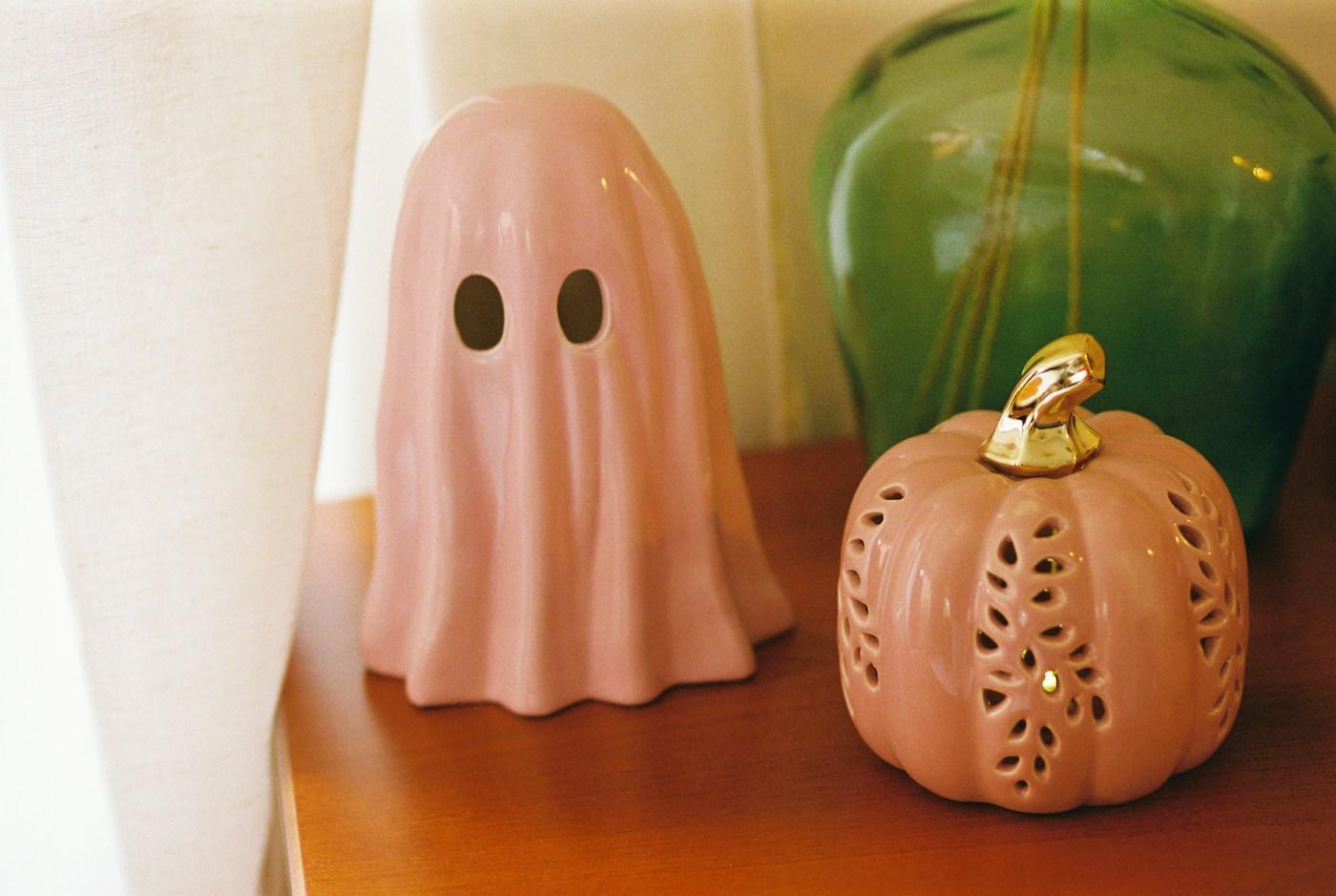
Clay lets you play with the same unsettling possibilities. A hollow vessel becomes a head. Cut openings into its walls, place a battery-operated light inside the finished piece, and its expression changes when the room goes dark.
The face you made in daylight might have other intentions after sunset.
And unlike a pumpkin, it can return next October. Your little household monster gets a recurring role.
Of course, we should keep the history honest. The fortune-telling game is documented. So are the vegetable lanterns. An ancient Halloween tradition of couples booking pottery classes is not. Nobody has uncovered a Celtic flyer advertising “Bring Your Own Mead.”
The workshop is our invention. The folklore gives us something worth imagining.
And imagination gets much more interesting when you stop demanding that everything turn out pretty.
Anyone who has tried the pottery wheel knows the negotiation. You want a tall, graceful vase. The clay is considering a shallow, emotionally exhausted bowl.
Usually, you try to correct it.
For Halloween, you might ask a different question: what could this become?
That sagging rim could be a creature’s lip. The swollen side could belong to a miniature cauldron. A handle could curl into a tail. A row of little clay teeth could turn an innocent planter into something you would hesitate to water.
Technique still matters. But a strange shape gives you something to respond to. You can follow it somewhere unexpected.
This is especially entertaining when you make pottery with someone you thought you knew.
Your sensible friend produces a cup with six eyes.
Your partner spends forty minutes sculpting a single perfect fang.
The quiet person at the table makes the most disturbing object in the room and politely asks where the carving tools go.
You learn things.
A Halloween pottery night can become a small exercise in inventing your own mythology. Make a creature that guards your keys. A bowl that eats your bad ideas. A ghost whose only unfinished business is finding its matching sock.
Give the object a job. Give it a weakness. Give it a ridiculous name.
Suddenly, you have a story you can hold.
At Color Cocktail Factory, that is the kind of Halloween we want to make room for: people gathered around clay, surprising themselves, laughing at what appears beneath their hands.
The old fortune-telling bowls offer another starting point. What would you put in a vessel to represent your future? What shape would you give a wish? What would a container for courage look like?
Those are contemporary questions inspired by the folklore. Your answers can be funny, tender, grotesque, or all three.
Perhaps your finished piece will sit beside the front door every autumn. Perhaps it will hold candy. Perhaps its expression will make visitors ask, “What is that supposed to be?”
Excellent. Now you get to tell them.
Once, at a Halloween gathering, choosing clay supposedly meant your story was ending.
At your pottery table, it can be where a very strange one begins.